MONOPOLY Live: Board and Bonus Feature Guide
MONOPOLY Live is a wheel-led game show whose bonus sequence moves a virtual character around a three-dimensional board. The wheel includes numbered outcomes, CHANCE and two distinct roll-entry categories; the board is a later phase, not an ordinary tabletop property-trading match. Evolution's launch announcement and current product explanation establish that relationship. 21
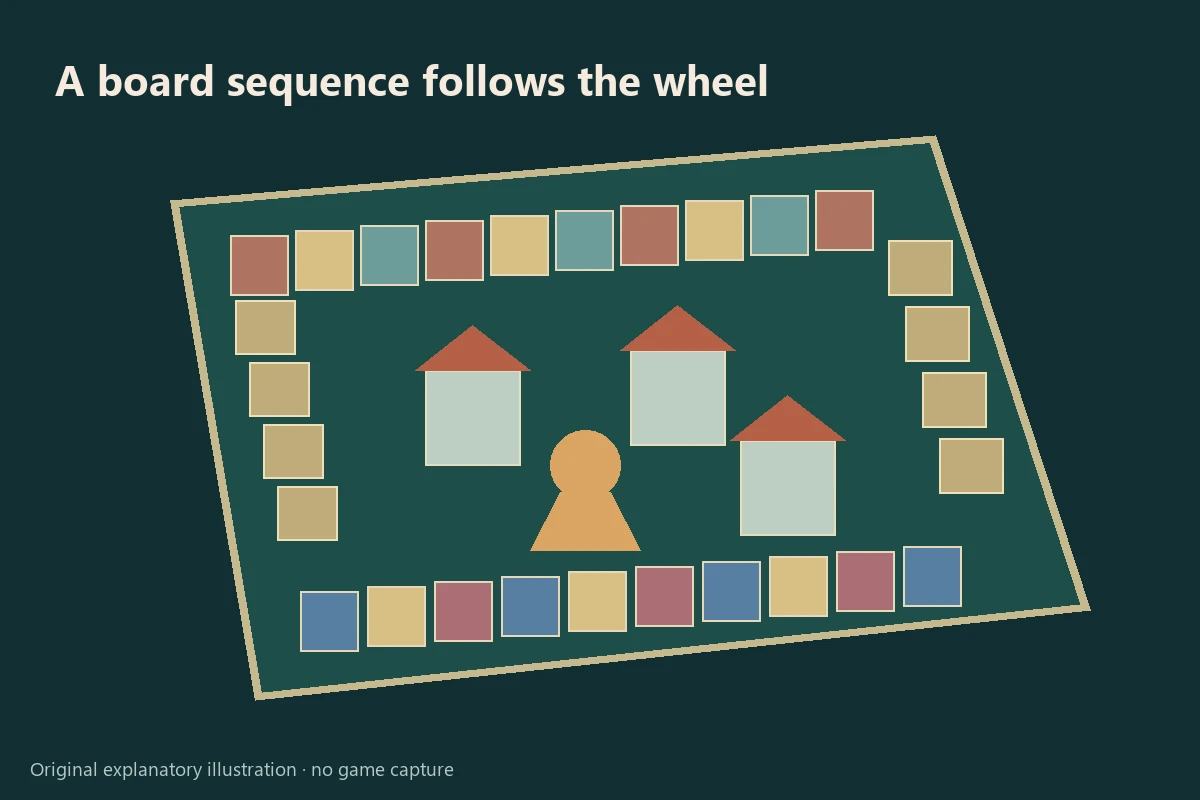
Begin with the board's role in the programme
The board is the setting for the bonus rather than the starting mechanism of each main round. Evolution introduced MONOPOLY Live in April 2019 as a special Dream Catcher edition using a live host, augmented reality and a three-dimensional bonus. The familiar board imagery provides context, but the programme's own published sequence determines what those objects mean here. 2
That distinction prevents a common explanation error. Someone familiar with a household board game may expect turns, ownership negotiations or a long contest between players. Those expectations are not evidence about this game show. The article instead follows the documented transition from a wheel category to a dice-driven movement sequence. A drawing of a board can explain movement without implying that the reader is buying properties or playing a full tabletop match.
The visual shift is substantial: a circular stopping mechanism gives way to a route with corners, squares and a moving figure. Nevertheless, the transition is still governed by the wheel category that opened the feature. A familiar house or token does not create an additional tabletop action. The board supplies a sequence of destinations for the virtual figure, while the studio dice supply movement totals. Keeping those roles apart makes the change of setting easier to follow.
Read the wheel as several kinds of outcome
The official wheel contains 54 equal segments with different functions. Evolution groups 48 under the number categories 1, 2, 5 and 10, with two CHANCE segments, three marked 2 ROLLS and one marked 4 ROLLS. The product page also says CHANCE is absent from the ordinary selection grid, even though it is present on the wheel. 1
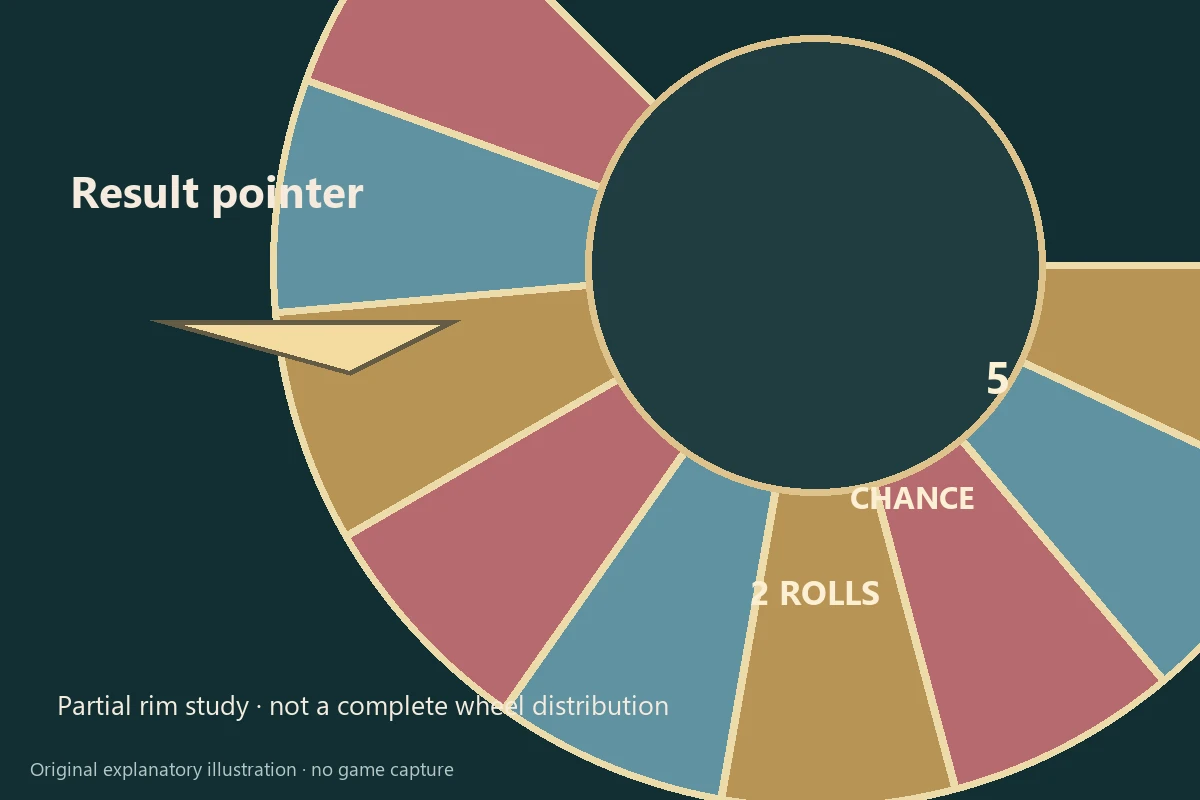
A wheel and its control grid therefore need not contain identical lists. The wheel identifies possible stopping categories, while the grid identifies the available selections described by the rules. An explanation that merely counts large control buttons can miss a category on the physical wheel. Likewise, seeing CHANCE in the studio does not by itself establish a separate CHANCE selection on the interface.
The flapper at the top of the wheel is the stopping indicator described by Evolution. Its role differs from a decorative graphic elsewhere in the studio: it associates the final wheel position with a category. When a camera moves closer to a sector, the change of framing does not create another outcome. A clear account keeps one spin and one stopping category together even when the programme shows them through several camera angles.
Separate the two CHANCE branches
CHANCE can produce a cash-prize outcome or a multiplier outcome, and the published explanation gives those branches different consequences. For the multiplier branch, the existing selections remain in place for another wheel spin, with the multiplier applying to the next relevant result. Repeated multiplier outcomes can combine, and a subsequent bonus-entry result carries the multiplier relationship into the board feature. 1
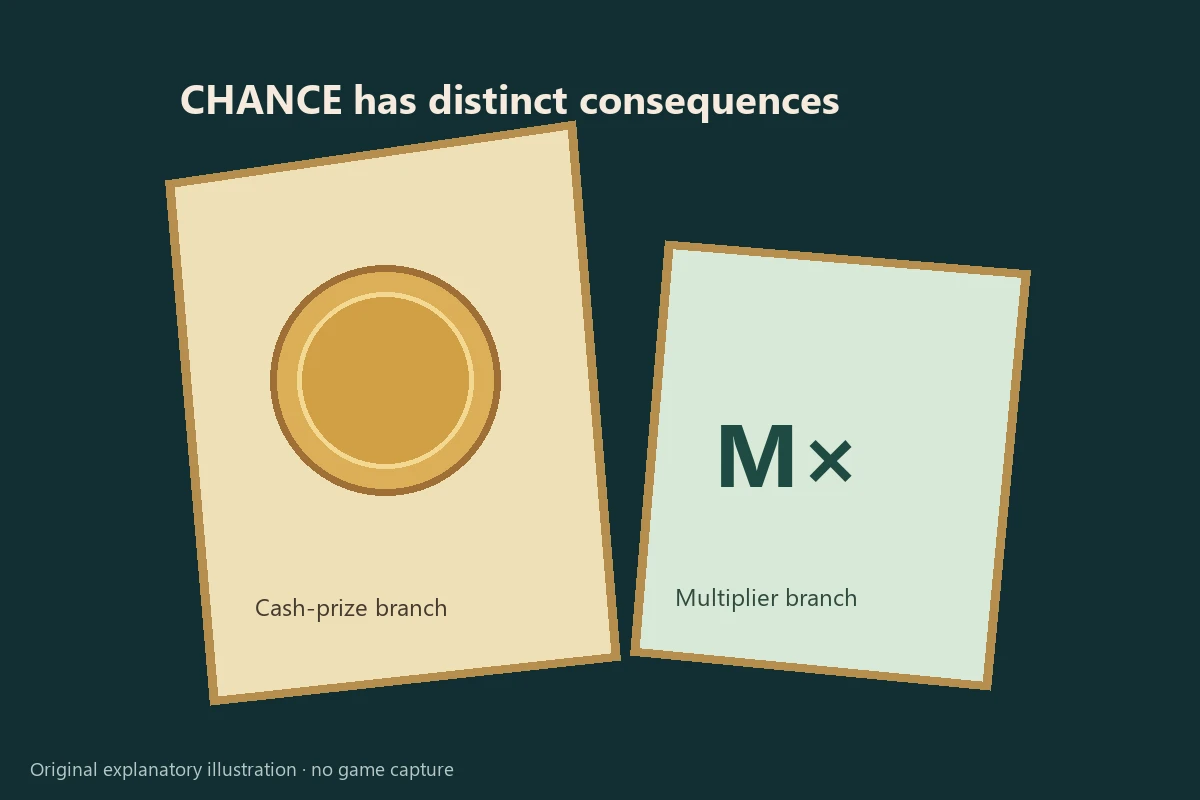
A cash-prize message describes an immediate branch, whereas a multiplier message carries an effect forward. The timing is the important difference. If another multiplier follows, the published explanation describes combining those multipliers, rather than treating the second card as a new unrelated numbered-wheel result. If the following outcome is a roll-entry category, the consequence has to be understood within the subsequent board feature. The CHANCE label alone does not identify which of these events occurred.
The useful question when reading a CHANCE scene is what the card says happened next. A value label alone may be incomplete if its effect belongs to the following spin or board sequence. A caption should identify both the branch and its timing. Describing every CHANCE appearance simply as a bonus round would remove the important difference between an immediate cash-prize outcome and a multiplier that changes the interpretation of a later event.
Treat 2 ROLLS and 4 ROLLS as distinct entries
The two roll labels identify separate bonus-entry categories, not interchangeable descriptions of a single selection. Evolution states that participation depends on the corresponding 2 ROLLS or 4 ROLLS selection; watching the board sequence does not itself establish participation. The published minimum is two dice rolls for the former category and four for the latter. 1
This is why the printed category name needs to remain visible in a written explanation. A general sentence that the wheel reached the board leaves out the entry that sets the starting roll count. For an invented transcript, record the category before describing the board movement. There is no need to add an imagined monetary value to preserve that event sequence.
A minimum roll count is also different from a guaranteed final number of rolls. The official page describes an additional roll for doubles, with an exception when doubles are used to leave Jail. A reader should not turn the label into an unconditional statement that the sequence must stop after exactly two or exactly four throws. The exception belongs beside the general doubles description rather than in a distant footnote. 1
Use the dice total to explain movement
The pair of dice determines how many board spaces the virtual figure moves in the bonus. The product description places the dice in the live studio and the subsequent movement on the three-dimensional board. A double can add another throw under the stated condition, while the sum still explains the movement for that throw. 1
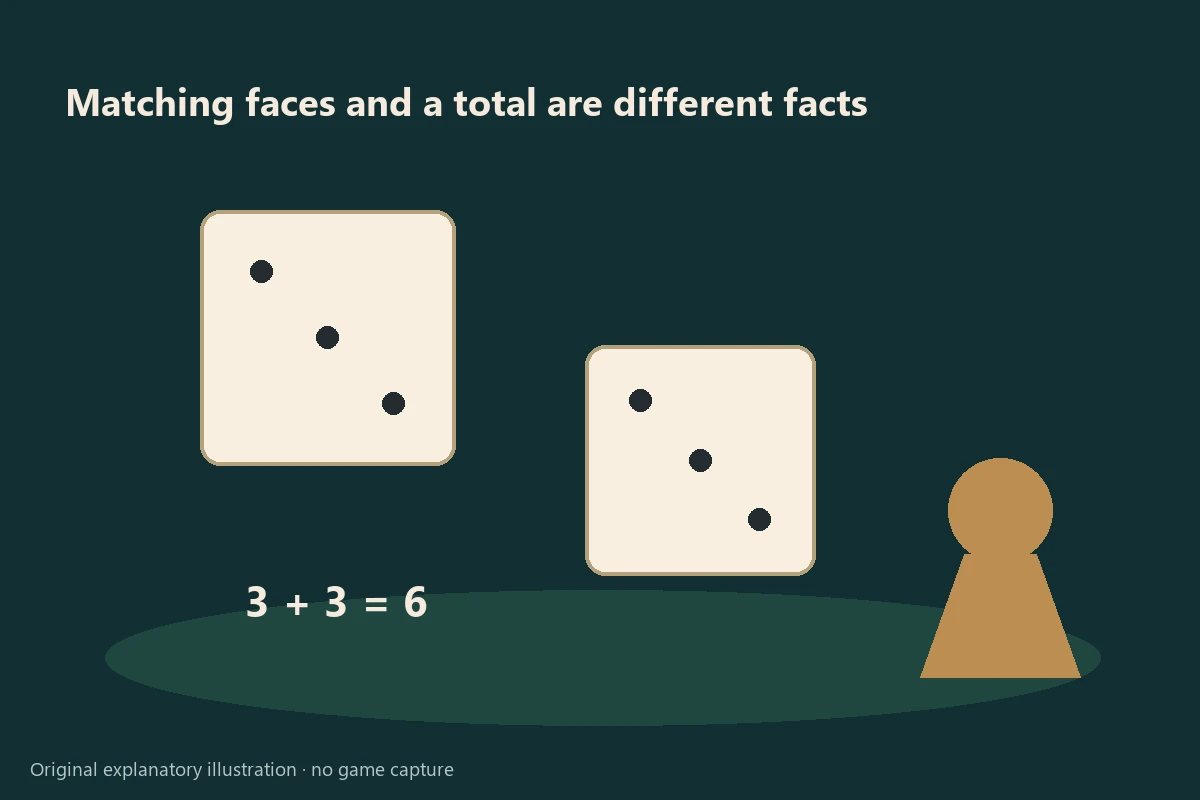
For an arithmetic example, two dice showing three each sum to six. The equality of their faces identifies a double; their sum identifies the movement total. These are two facts about the same throw, not two competing ways to read it. Another pair could have the same sum without being a double. The additional-roll condition therefore depends on the matching faces and the stated Jail exception, rather than on the total six by itself.
Following an edited sequence becomes easier when three details are kept apart: the remaining roll allowance, the values on the dice and the token's destination. An extra roll affects the first; a dice total affects the second-to-third relationship. This is a practical reading framework built from the published mechanics, rather than a claim that board appearance reveals an advantage.
Keep presentation variants within their documented scope
The official product page identifies a British board presentation by default and mentions German and Italian alternatives. Those are presentation references, not evidence that a Philippine interface contains a particular language, address set or locally authorised service. The publication establishes what Evolution describes; it does not establish the configuration of an unexamined operator page. 1
For an editor, the safest board description uses the exact category and object needed for the passage. A general route can demonstrate movement; an exact named-square claim needs the corresponding version. This keeps the explanation useful without copying protected board artwork or filling a missing screenshot with invented street names. The reader can then distinguish the core wheel-to-board format from details that depend on the displayed edition.
Questions about the format
Why is the board not shown at the start of every round?
The published format starts with the wheel. The board is the later bonus setting reached through its designated roll-entry categories.
Is CHANCE a normal button on the selection grid?
Evolution’s product page says CHANCE appears on the wheel but not on the ordinary selection grid. These are different information surfaces.
Do 2 ROLLS and 4 ROLLS mean exact final counts?
They establish minimum counts in the official explanation. Doubles can add a roll, with the stated exception for doubles used to leave Jail.
Does a familiar board prove a local operator is licensed?
No. A theme identifies content. Philippine operator authorisation requires a separate check against PAGCOR’s records and the exact service identity.